Founding batch · Fall 2026
Know what you are
actually breathing.
Canary is a pocketable environmental monitor with an e‑paper display. Seven sensors, a full day of history on screen, and nothing to subscribe to. Put it on a desk, a nightstand or a nursery shelf and it just keeps watch.
- PM2.5Particulates
- PM10Coarse dust
- CO2Stale air
- UV‑B240–320 nm
- °C / °FTemperature
- %RHHumidity
- kPaPressure
The device
More than a monitor.
Most air quality gadgets give you one number and a coloured ring. Canary gives you the shape of your whole day.
An e‑paper display that never asks for your attention.
No glare, no backlight glow at 3am, no notification badge. The screen holds its last reading even between refreshes, and it stays legible in direct sunlight.
-
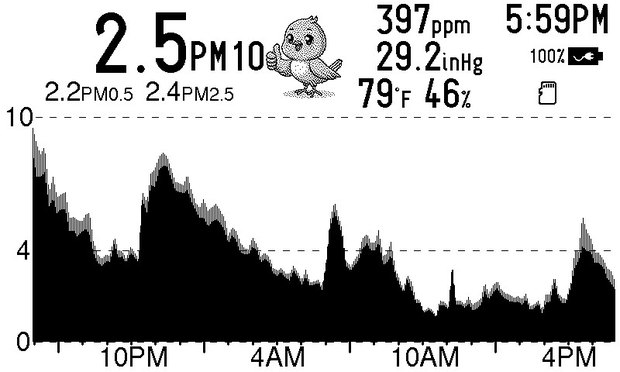
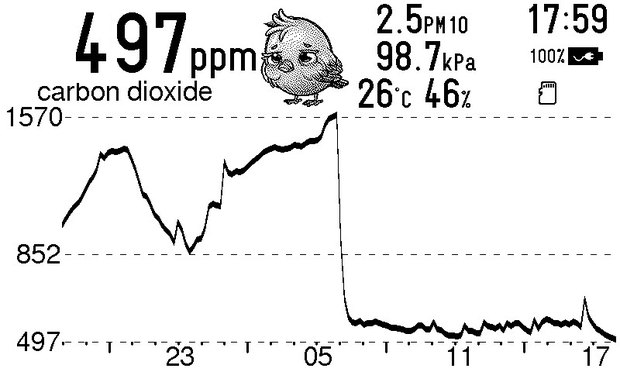
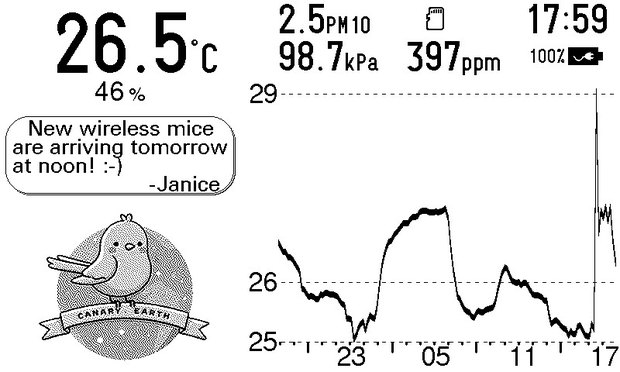
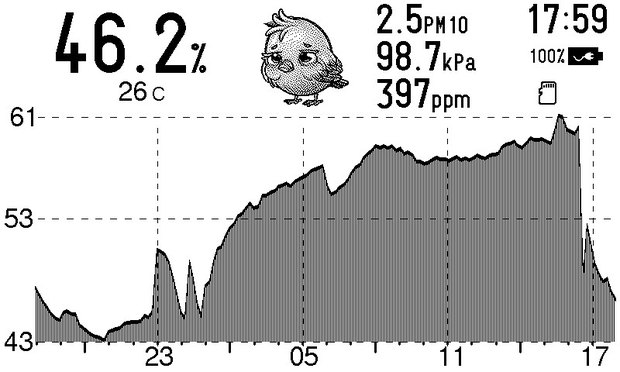
24 hours on screen
Every sensor plots its own history, so you see the spike and what caused it — not just the number right now.
-
Logs to a microSD card
Months of readings written locally. Pull the card, open the file. Nothing is held hostage behind an account.
-
No subscription, no cloud requirement
Canary works fully offline. If you want dashboards and remote alerts, you can run the server yourself.
-
Yours to reconfigure
Build your own screen layouts, choose which readings sit where, and schedule what the display fetches.
Seven sensors
Every reading, plotted.
Sensor modules sourced from Switzerland, Germany, Korea and Canada — each one drawing its own 24‑hour trace on the e‑paper screen.
It smells smoke before you do.
A dual‑laser sensor counts particles down to PM0.5 — wildfire smoke, cooking fumes, wood burning, the dust from a renovation next door. These are the particles small enough to travel deep into your lungs, and the ones outdoor air quality reports cannot see inside your walls.
Watch a closed room go stale.
A Swiss laser‑based CO2 sensor, accurate enough to count how many people walked into a room. Rising CO2 is the clearest signal that a space has stopped ventilating — and the reason a bedroom or a meeting room quietly drains your concentration.
The microclimate your thermostat misses.
Your hallway thermostat does not know what the nursery does at 4am, or how hot the conservatory gets by noon. Leave a Canary in the room that matters — or with the pets and plants you left at home.
Weather you can feel coming.
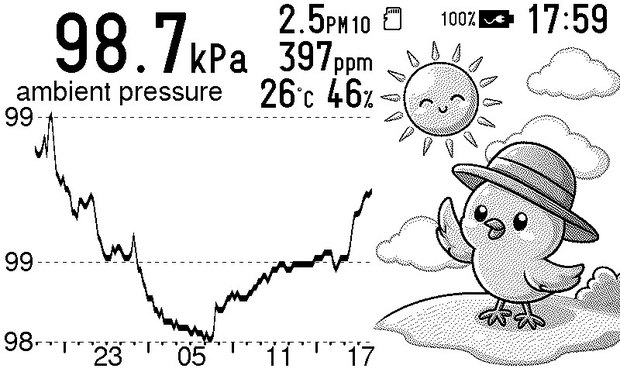
A falling barometer arrives hours before the storm does — and often before the headache or the aching joint that comes with it. Canary keeps the curve, so a pattern you had only suspected becomes something you can actually point at.
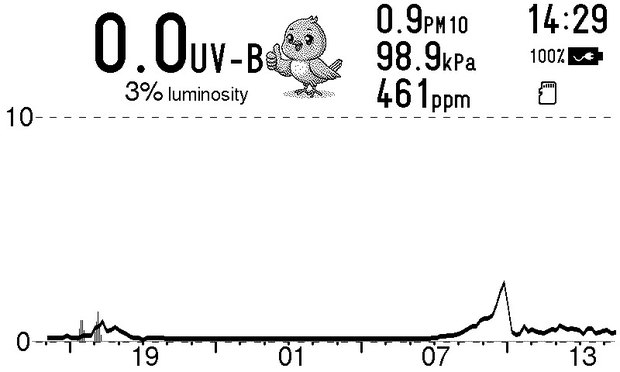
Measures the 240–320 nm band that actually burns skin, rather than estimating it from visible light like most consumer sensors.
Too dry cracks skin and sinuses; too damp invites mould and dust mites. Canary shows you which way your rooms actually drift.
Not just how much, but how big. The size distribution is what separates kitchen grease from road dust from wildfire smoke.
In the wild
Where Canary lives.
At home
The overnight hump nobody knew about.
In hand
Pocketable. Readable in full sun.
At the table
Silent. No fan, no chime, no glow.
On the desk
A whole working day, at a glance.
Mask test
Find out what your respirator really filters.
Right to repair
Built to be opened.
Every part you can see here is a part you can replace. The battery, the e‑paper panel, the sensor module, the USB‑C board — all of it comes apart with ordinary tools and goes back together again.
We would rather sell you one Canary that lasts a decade than five that do not. That is a design constraint, not a marketing line: no glue where a screw would do, no pairing locks, no parts you have to ask our permission to buy.
Specifications
The numbers.
Seven sensor modules, one e‑paper screen, and a battery that charges over the same USB‑C cable as everything else you own.
Display
- Type
- E‑paper, monochrome
- Diagonal
- 4.26″
- Resolution
- 800 × 480
- Backlight
- None
Power
- Battery
- 2000 mAh Li‑po
- Charging
- USB‑C
- Reported telemetry
- Voltage, charge state
Connectivity & storage
- Wireless
- Wi‑Fi, Bluetooth
- Mesh
- ESPNow®
- Wired
- USB‑C
- Logging
- microSD card
- Server
- Self‑hosted, optional
Particulates
- Mass concentration
- PM1.0 · PM2.5 · PM4.0 · PM10
- Number concentration
- PM0.5 · PM1.0 · PM2.5 · PM4.0 · PM10
- Typical particle size
- Reported
- Method
- Dual‑laser scattering
Air & climate
- Carbon dioxide
- ppm, NDIR
- Temperature
- °C / °F
- Relative humidity
- %RH
- Barometric pressure
- kPa / inHg
Light
- Ultraviolet
- UV‑B, 240–320 nm
- Ambient light
- Luminosity
On screen
- History
- 24 h per reading
- Layouts
- User configurable
- Units
- Metric or imperial
Sensor modules sourced from Switzerland, Germany, Korea and Canada. Every one of them is a replaceable part.
Early users
Tested in real rooms.
Founders, operators and educators who put a Canary on their desk before we had a website to put it on.
Canary is a game-changer for executive health, keeping my air clean and my focus sharp during long investment strategy sessions at the office.
As a high-growth tech operation, keeping our team's workspace healthy is critical, and Canary ensures our indoor air quality matches our high performance.
Developing global hardware partnerships requires endless travel and long boardroom hours; Canary keeps my immediate breathing space healthy wherever I land.
In our educational workshops, a healthy environment is the foundation for learning, and Canary helps us ensure our spaces promote peak cognitive focus.
Hosting community events and collaborative wellness workshops means prioritizing guest safety; Canary gives us visual assurance of clean, safe indoor air.
As a technical founder constantly working around server racks and development hardware, Canary is essential for keeping my lab environment healthy.
Canary for organizations
One room, or two hundred.
Canary units find each other over ESPNow® and form their own mesh — no site‑wide WiFi rollout, no per‑device provisioning. Readings land on a server you host, on your own network, behind your own door.
-
Mesh networking
Units relay for each other across floors and outbuildings where WiFi does not reach.
-
Privacy-first by architecture
Nothing leaves the building unless you route it there. Straightforward when the rooms are classrooms.
-
HVAC that answers to evidence
Find the meeting room that never clears, the wing the air handler forgot, the hour your filters stop coping.
-
Campus-wide smoke alerting
When wildfire smoke reaches the property line, every unit knows — and so does whoever decides about outdoor break.
Founding batch
First units, first price.
The founding batch is small and hand-checked. Waitlist members get early-bird pricing and the first shipping slots.
- Canary monitor, soft-touch enclosure, USB‑C cable and microSD card
- All seven sensors — nothing behind a paywall or a firmware tier
- Replacement parts and schematics available from day one
- Self-hosted server software, free and unlimited
Joining the waitlist does not charge you anything and does not commit you to buying.
The waitlist
Be first in line.
Leave your email and we will tell you once — when the founding batch opens, with your early-bird price attached. That is the entire mailing list.
Before you ask
Questions, answered.
What does Canary measure?
Fine particulate matter (PM2.5, and coarser and finer fractions), carbon dioxide, UV‑B, temperature, relative humidity and ambient pressure. Particulates are the tiny airborne particles produced by wildfire smoke, traffic, wood burning and cooking, and they are one of the most important indicators of air quality.
Why does PM2.5 matter?
PM2.5 particles are roughly 30 times smaller than the width of a human hair. Because they are so small they can be inhaled deep into the lungs, and may affect everyone — especially children, older adults, and people with asthma or other respiratory conditions.
Can Canary detect wildfire smoke?
Yes. Wildfire smoke is largely made up of fine particulate matter, which is exactly what Canary is built to monitor. During wildfire season it helps you understand how much smoke is making its way indoors, so you can act when it does.
Why monitor indoor air when I can check the forecast?
Most people spend around 90% of their time indoors, and outdoor air quality reports cannot tell you what is happening inside your home. Indoor air varies enormously with ventilation, filtration, cooking, candles, fireplaces, and whether smoke is getting into the building.
Is it suitable for a nursery?
Yes, and it is one of the most common places people put one. There is no backlight and no sound by default, so it will not disturb a sleeping child while it tracks the room overnight.
Does Canary clean the air?
No. Canary measures air quality; it does not filter it. Think of it as the information that tells you when to run the purifier, open a window, or change an HVAC filter — and, just as usefully, when you do not need to.
How accurate is it?
Canary uses high-quality sensor modules built for continuous monitoring. No consumer monitor is intended to replace laboratory equipment, and we will not claim otherwise — but Canary gives reliable, consistent measurements that let you track how your air changes over time, which is what actually drives decisions.
Where should I put it?
In the room where you spend the most time — a living room, bedroom or nursery. Avoid placing it right beside a window, a vent, the stove or a humidifier, since those will skew the readings locally rather than tell you about the room.
Will cooking set it off?
It will show it, and that is the point. Frying, grilling and high-heat cooking produce a lot of PM2.5. Most people are genuinely surprised to find that making dinner can briefly push indoor particle levels past what is outside during a pollution event.
Is this only useful during wildfire season?
Plenty of people buy one because of smoke and then keep using it year-round. Indoor air shifts constantly with cooking, wood-burning stoves, seasonal allergens, renovations, and how tightly the house is shut against the weather.
Do I need to be technical to use it?
No. Out of the box you place it somewhere and read the screen. The mesh networking, self-hosted server and custom screen layouts are there if you want them, and entirely ignorable if you do not.
What happens when I join the waitlist?
We store your email address and use it once, to tell you the founding batch is open, with your early-bird price. No newsletter, no sharing with anyone else, and an unsubscribe link in the same email. Joining costs nothing and commits you to nothing.